Counting Calories: Put Your Facility on a Diet

Hixson has observed from decades of plant surveys and client data that food processors will lose on average between 2% to 5% of their ingredients and products as waste. These losses typically occur with process line and tank cleaning, water pushes to drain, line start-ups, and equipment outages. Losses in excess of these averages typically result in Biochemical Oxygen Demand (BOD)-rich wastewater effluent to their own waste treatment plant or the municipal sewer, resulting in expensive surcharges. In addition, some companies may operate in municipalities that simply do not have the capacity to treat any more waste and limit the BOD permitted altogether.
To reduce BOD loads, it is important to have an understanding of the BOD values of your company’s products. The BOD value of food is directly related to the caloric content of the ingredients or final food product. Fat, carbohydrates, and protein all contribute to the BOD value. While some common food BOD values are published in literature, the wide variety and unique properties of today’s manufactured products can be estimated with the following equation:
BOD5 (mg/L) = 10,000 x [(89 x Wt.% Fat)+(69.1 x Wt.% Carbs)+(103.1 x Wt.% Protein)]
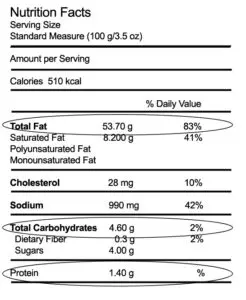
Based upon the label below for a ranch-style salad dressing, the BOD5 value would be approximately 525,000 mg/L, or 0.525 pounds BOD for every pound of salad dressing lost to the drain:
BOD5 (mg/L) = 10,000 x [(89 x 0.537)+(69.1 x 0.046)+(103.1 0.014)]
By knowing your product BOD, you can estimate the product losses and the value of BOD surcharge can be documented. Then programs and/or capital investments can be justified and installed to reduce the product losses and BOD expenses.
In addition to the recovered cost of the BOD surcharges, you should also take into account the lost value of product sold.
In the example below, assume this manufacturer has a total untreated discharge of 100,000 gallons of effluent, with an average BOD5 of 500 mg/L. This represents 417 pounds of BOD5, or a daily loss of 794 pounds of salad dressing with a market value of more than $2,500! Stemming these losses involves a variety of practices and equipment configurations. Awareness of the impact of these losses, and diligence on the part of operations, are important first steps to “counting the calories” and keeping operations as “lean” as possible.
Experience in Brief
| BOD Conversions | |
|---|---|
| Ingredient: | Lb BOD per 100 lb Ingredient: |
| Whole Milk | 10.4 |
| Skim Milk | 7.4 |
| 40% Cream | 39.8 |
| Sugar | 68.6 |
| Cocoa | 68.2 |
| Cheddar Cheese | 55.9 |
| Canned Peaches | 8.8 |
| Walnuts | 85.2 |
Converting to lbs:
Lb/day = B x G x C
Where:
B = BOD mg/liter
G = Flow in Gal/day
C = 0.00000834
Sign Up For More Insights
Connect with the latest industry trends and insights with our newsletters. We provide the knowledge that powers the future.
Subscribe now